
The Leadership Lens · Sample issue · October 2026
Beliefs vs. practice: why your leadership team cannot agree on change
Your leadership team is debating how to implement a new approach (for example, to reading or instruction across the school). Some want whole-school professional learning upfront, while others push for a small pilot.
The idea in brief
The conversation goes in circles because you are wrestling with something deeper. Do you change beliefs first, or do you try changing practice first? A 5-minute line-up exercise exposes these hidden assumptions so your team can lead change more intentionally.
A closer look
I use this exercise to kick off workshops on leading change or overcoming resistance in a school. I call it the Change Line-Up.
It is straightforward. I ask school leaders to think of an initiative or school-wide change they need to lead in the next year. For example, it might be implementing explicit instruction approaches, phonics, or a trauma-informed practice framework.
Next, I introduce the spectrum: beliefs at one end, practice (or behaviour) at the other. We use a wall as our spectrum.
I then ask: “Should you start leading this change by changing practice first, or by changing beliefs first?”
Participants then physically go and line up where they believe they should start. There is always a healthy distribution.
I then ask them to “Turn and discuss why you are standing where you are standing.”
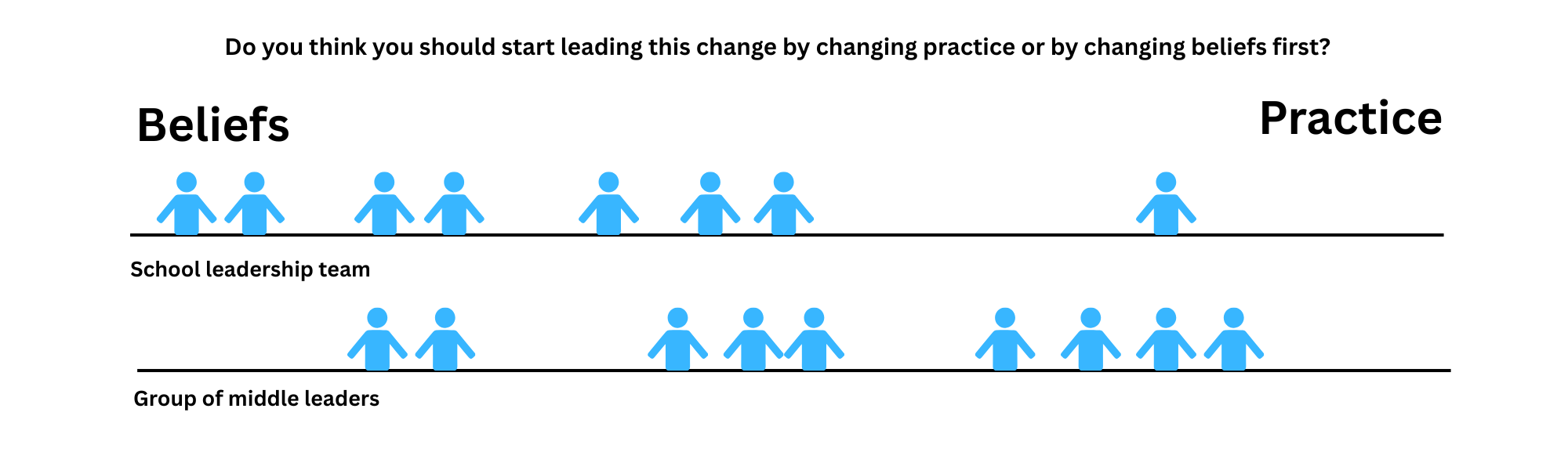
Different groups can hold very different points of view about how change works best. Real examples from the same school, its leadership team and a cohort of middle leaders, show this clearly. Notice too the range of views within each group. Most teams have never discussed this. Yet these beliefs fundamentally shape how they lead, and how they respond when colleagues take the lead.
Those at the beliefs end often talk about the importance of explaining the “why” of change. This requires the important leadership practice of storytelling.
Those towards the practice end often reason that insight or beliefs do not necessarily lead to action. As one deputy principal put it to me recently, “We all know we should exercise more, but knowing doesn’t get us to the gym.”
What I have found is that this simple exercise opens up conversations that leadership teams really need to have. It helps them become far more intentional about how they design and lead change together.
What the research suggests
Different bodies of research take different views on this question.
Educational research shows us that:
teachers with strong self-efficacy and positive perceptions of an approach are more likely to implement it faithfully
if you do not believe it is worthwhile or possible, you are unlikely to persist.
Implementation science and change management approaches argue that:
starting with behaviour is more effective
creating structures, routines and supports (for example, coaching and leadership) helps people try something new
the act of doing it can help shift beliefs
getting proof that it works in your context, “with our schools and our kids”, can help with resistance.
In my experience working with school leaders, both are essential. Beliefs shape commitment; practices can, under the right conditions, help change beliefs and create evidence in your context. The useful stance is not “either/or” but “both/and”.
Change is always contextual and relational. If your leadership team leans heavily toward beliefs first, you risk a lot of talk about the “why” without action. If you lean only toward practice first, you may see compliance initially, but commitment falls away once attention shifts.
Of course, there is more to making change last than balancing beliefs and doing: creating time, the right structures, organisational routines and leadership support that turn new approaches into habits.
Try this →
At your next leadership meeting, try the Change Line-Up. Ask:
Should we start leading this change by changing practice first, or beliefs first? Each person lines up where they stand.
Why are you standing where you are standing?
What might we need to adjust as we lead change together?
Learning with you,
Ricky
Enjoyed this? Get The Leadership Lens in your inbox.
One idea and one thing to try, from my work with school and system leaders. Sign me up →